

Meta Ads Delivery Stuck? The New Battle Between Manual Control and AI Automation
In our previous article, Meta Advantage+ AI Ads: Conversion Revolution or Automated Budget Burner?, we explored how Meta's automated targeting often trades lead quality for vanity metrics. We looked at how full AI automation can flood accounts with spam messages, fake form fills, and phantom views on third party networks.
Following that breakdown, thousands of media buyers made a deliberate strategic choice. They decided to take back control. They returned to manual targeting, carefully uploaded high value customer lists to build 5% or 10% lookalike audiences, configured strict location parameters, and set competitive budgets to protect lead quality.
Then a brand new nightmare appeared.
Instead of getting high quality leads, many marketers woke up to find something worse: the ads simply will not run. The campaign status shows Active, the budget is set well above recommended thresholds, the audience list is verified, yet total spend remains at zero dollars.
Why is this happening? Why is Meta effectively throttling manual campaigns? More importantly, why does advice from Meta support representatives feel completely disconnected from performance marketing realities?
Let us unpack what is happening behind the scenes in the Meta auction, evaluate the questionable advice given by support channels, and look at grounded steps to get your manual ads moving again.
The Non Delivering Ad Phenomenon: What Marketers Are Seeing
When you launch a campaign using custom lookalike audiences or detailed interest targeting, Meta enters your ad into real time auctions. In previous years, setting a healthy budget meant guaranteed impressions. Today, manual campaigns frequently experience a total freeze.
Modern media buyers rarely use lookalikes below 5% anymore because micro audiences saturate within days and restrict delivery under current auction rules. Marketers naturally turn to 5% or 10% lookalike tiers to maintain reasonable scale while keeping targeting rooted in actual buyer data.
Here is the standard scenario playing out across media buying accounts:
You create an ad set targeting a 5% or 10% Lookalike Audience built from your highest value customer list.
You allocate a daily budget two to three times higher than Meta's baseline recommendation to ensure the campaign gets traction.
You set up clean, high converting creative assets that have historically proven successful.
You publish the campaign, wait past the standard approval window, and watch the dashboard.
Result: Zero impressions. Zero spend. The delivery status says Active, but nothing happens.

Manual target setting with zero result
When performance marketers face this wall, the natural next step is reaching out to Meta Support. That is where the story gets even stranger.
Deconstructing Meta Support Advice: Does Any of It Make Sense?
If you request a support call or open a chat ticket regarding stuck delivery, support executives usually follow a very rigid script. Their recommendations often leave direct response marketers scratching their heads.
Here are the three most common suggestions given by Meta representatives, along with an honest analysis of why they cause so much confusion.

Our honest analysis of why these recommendations cause so much confusion
Claim 1: "You must turn on Advantage+ features or ads will not deliver."
Meta representatives will almost always point out that your campaign lacks Advantage+ Audience or Advantage+ Placements. They explain that because you restricted the machine learning algorithm with strict manual parameters, the system cannot find eligible auctions.
The Reality: While it is true that broader targeting gives the algorithm more auction flexibility, manual targeting has worked reliably for over a decade. Telling a marketer to turn on Advantage+ to fix delivery ignores the exact reason why they turned it off in the first place: protecting lead quality. Forcing automated broad expansion as the only path to ad delivery feels less like an optimization tip and more like algorithmic pressure.
Claim 2: "You need a mix of image and video creatives inside every single ad set."
Support reps often state that if an ad set only contains static image ads, the system throttles delivery. They insist that you must upload video creatives into the exact same ad set alongside images so the algorithm has various formats to serve.
The Reality: Different placement slots (such as Instagram Reels or Facebook In Stream) favor video formats, but static images remain incredibly effective for direct response conversions. Forcing a media buyer to produce video content just to unlock delivery on image ads makes little practical sense. An ad set with three high quality static images should easily win auctions in feed placements without needing a video asset attached.
Claim 3: "Lower your paid ad budget and build organic signal by doing Facebook Live or Instagram Live."
Perhaps the most bizarre advice given to performance marketers is the suggestion to cut paid advertising spend and start running live broadcasts on Facebook or Instagram.
The Reality: For a business attempting to run predictable, scalable paid customer acquisition, going Live is rarely a viable substitute. Direct response paid ads rely on immediate commercial intent and structured landing page funnels. Live streams serve organic audience building and community engagement. Advising a paid ads marketer to stop spending on paid conversion campaigns and go Live on social media shows a fundamental misunderstanding of direct response marketing goals.
Why Are Manual Ads Actually Stuck? The Real System Drivers
If the support script does not tell the full story, what is actually causing manual ads to freeze?
Meta's auction formula relies on three core factors:
Total Value = Bid x Estimated Action Rate x Ad Quality
When your manual ads refuse to spend money, it almost always traces back to friction within these three variables rather than a simple toggle switch.
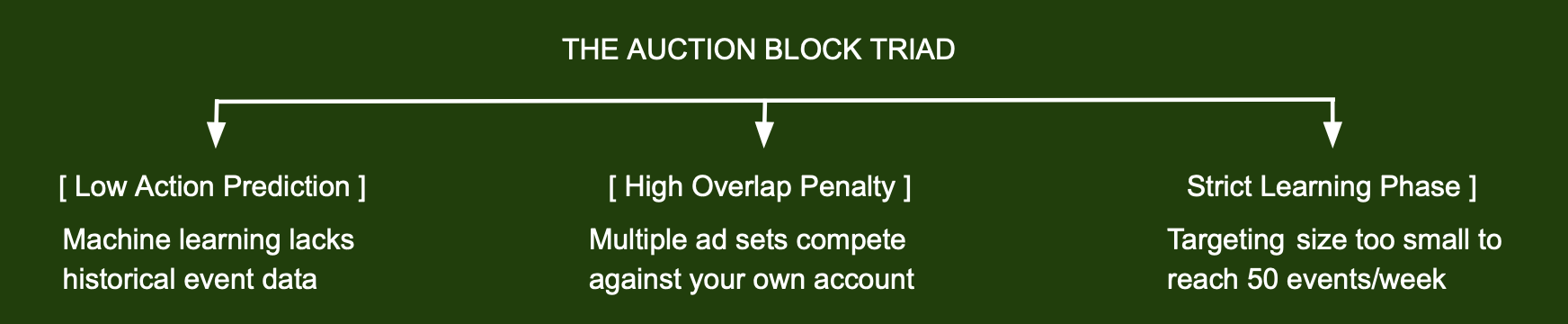
Three core factors
1. Predicted Action Rate Suppression
Meta relies heavily on deep learning models to predict whether a specific user will take your desired action (such as a purchase or lead submission). If you run a brand new campaign using manual targeting, the algorithm evaluates your historic account data. If the model calculates that your predicted action rate within that audience is too low, it simply will not submit your bid into the auction. This keeps spend at zero even if your daily budget is massive.
2. Extreme Auction Overlap
When marketers create multiple manual ad sets targeting overlapping custom lookalikes (for example, a 5% Lookalike and a 10% Lookalike without mutual exclusions), the account begins bidding against itself. Meta has automated safeguards that prevent self competition. To protect your account from driving up its own costs, the system throttles delivery on the weaker ad set entirely.
3. The 50 Event Learning Threshold Barrier
Meta prefers ad sets that can generate roughly 50 optimization events per week. When you use manual targeting with strict demographic filters on high friction events (like Purchases or Completed Registrations), the algorithm calculates that you cannot hit that 50 event bar. Consequently, the ad set gets trapped before spending a single dollar.
Manual Control vs. Full Automation Comparison
To help evaluate your campaign setup, here is how manual configuration compares to Meta's automated ecosystem on key operational factors:
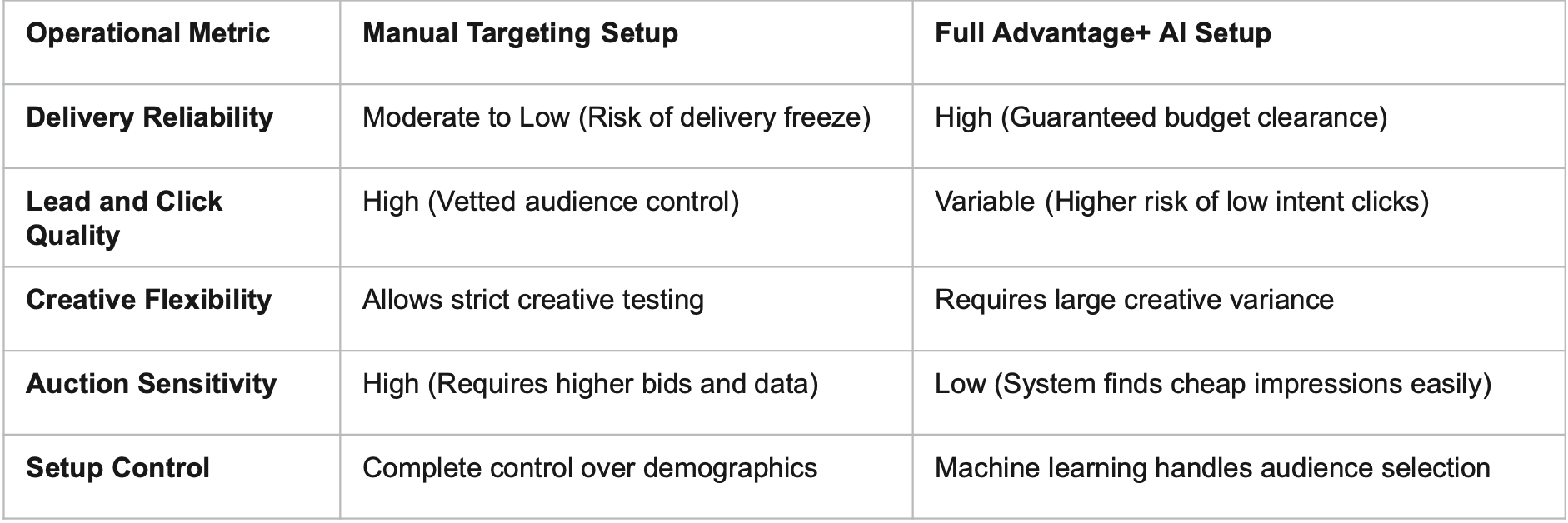
Manual Control vs. Full Automation Comparison
How to Unfreeze Stuck Manual Ads Without Sacrificing Lead Quality
If your manual ads are stuck at zero spend, you do not have to surrender completely to broad Advantage+ settings. You can resolve delivery blocks while maintaining control over audience intent by using these strategic adjustments:
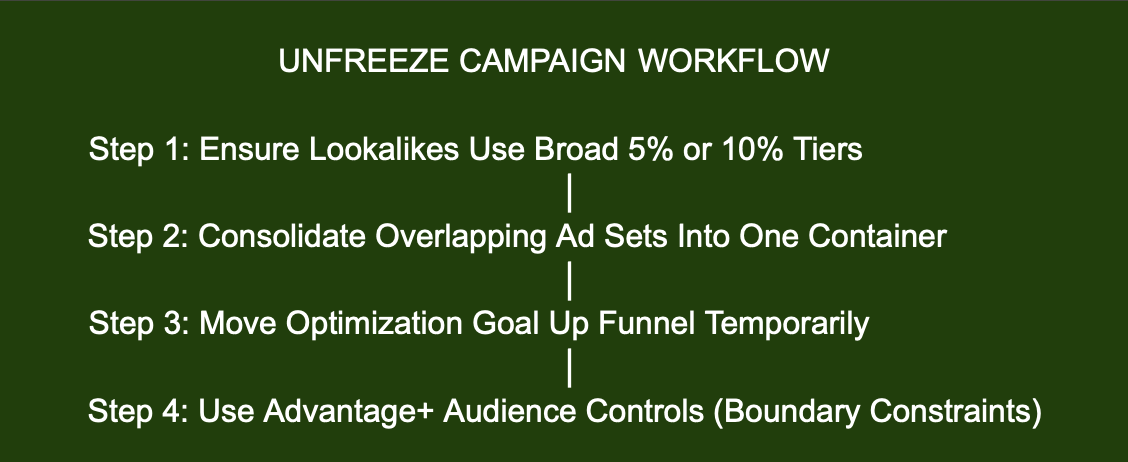
4 Steps to Unfreeze Campaign Workflow
1. Stick to Broader 5% or 10% Lookalike Tiers
Because 1% lookalikes exhaust rapidly and trigger instant delivery bottlenecks, modern marketers rely almost exclusively on 5% or 10% lookalike audiences. These larger pools give Meta sufficient auction space to deliver impressions while keeping your underlying targeting anchored to verified buyer lists.
2. Consolidate Segmented Ad Sets
Running four different manual ad sets simultaneously splits your budget and triggers auction overlap penalties. Combine those audiences into a single ad set. Consolidating budget gives Meta enough data density to pass initial delivery checks.
3. Optimise Up Funnel Temporarily
If your campaign is set to optimize for Purchases or Final Form Submissions and remains frozen at zero spend, change the optimization goal to an earlier step in the user journey (such as Add to Cart or Landing Page Views) for the first 48 hours. Once the campaign breaks out of zero spend and builds delivery momentum, duplicate the ad set and switch the goal back to downstream conversions.
4. Leverage Advantage+ Audience Controls (Not Full Automation)
Instead of switching to full Advantage+ Audience, use Audience Controls. This feature allows you to set hard boundaries (such as minimum age, strict geographic locations, or excluded custom audiences) while letting Meta search broadly within those specific guardrails. This compromise satisfies Meta's delivery algorithms without exposing your ads to random off platform traffic.
Final Thoughts for Media Buyers
The shift toward ad automation has created a genuine dilemma for performance marketers. While Meta continues pushing full AI automation through support channels and account managers, blind adoption can lead to low quality lead volume. On the flip side, overly restrictive manual setups can freeze ad delivery entirely.
The solution lies in finding the middle ground. By understanding how the auction formula evaluates risk, keeping lookalikes at broad 5% or 10% levels, consolidating your ad structures, and utilizing soft audience boundaries, you can keep your ads spending reliably while protecting the bottom line quality of your conversions.
-
Tighter 1% lookalikes cover a very small fraction of the population. In modern Meta ad auctions, micro audiences quickly trigger delivery blocks because the algorithm struggles to find enough cheap actions. Using 5% or 10% lookalikes expands the audience pool significantly, giving Meta room to spend budget while preserving signals from your original customer list.
-
Yes, static images can deliver successfully on their own. While support representatives encourage adding videos to unlock placement inventory, static images still win auctions in major feed placements if your audience size and bidding setup are healthy.
-
No. Organic Live video broadcasts have zero direct programmatic link to paid ad auction delivery mechanisms. Live streams build brand engagement, but they do not resolve paid campaign delivery blocks caused by auction suppression or ad set overlap.
-
This usually indicates audience exhaustion or high auction overlap. If you are using a narrower lookalike, expand it to a 10% lookalike tier. Also check if another active ad set in your account is targeting the same custom audience source.
