

Meta Advantage+ AI Ads: Conversion Revolution or Automated Budget Burner?
If you have spent any time inside Meta Ads Manager recently, you have likely noticed that the platform really wants you to hand over the keys to its artificial intelligence.
Between Advantage+ Audience and Advantage+ Placements, Meta’s message to media buyers is crystal clear: Stop tweaking settings manually. Trust the algorithm, sit back, and let AI optimize your budget.

Meta Advantage+ setting transitions from manual to AI Automation
However, if you talk to experienced media buyers, agency leads, and growth marketers, you will get a very different picture. While Meta promises lower Costs Per Click (CPCs) and machine-learning efficiency, actual client account data often tells a rockier story.
Is Meta’s AI actually driving profitable growth, or is it simply a clever mechanism to monetise cheap, low-intent ad inventory?
Let's break down how these AI features work, what the marketing community thinks of them, and why real-world account results? Including our own agency experience; frequently clash with Meta’s slick dashboards.
What Marketers Really Think: Meta AI vs. Manual Targeting
The consensus among digital marketers is far from unanimous, but it generally breaks down into two distinct camps:
1. The E-Commerce & Scale Advocates
Marketers managing large-budget e-commerce brands with broad appeal (like apparel, beauty, or consumer gadgets) often report success with Advantage+ campaigns. When an account already has thousands of historical conversions, Meta's AI uses those signals to find buyers quite well. For these accounts, the algorithm frequently delivers a lower Cost Per Acquisition (CPA) than tightly constrained manual audiences.
2. The Niche, B2B, & Lead-Gen Skeptics
For niche services, localised businesses, high-ticket B2B offers, or newer ad accounts without deep conversion history, marketers remain deeply skeptical of full AI auto-targeting. Without tight constraints, the AI tends to drift toward the path of least resistance: chasing cheap engagements, accidental clicks, and low-quality leads to artificially satisfy the ad objective.
Most seasoned media buyers now use a hybrid testing model rather than blindly trusting one method. They launch manual, interest-based targeting alongside Advantage+ campaigns to let real-world bottom-line revenue, not vanity platform metrics which determine the winner.
Decoding "Audience Network": Who Are They and Why Does the Name Matter?
To understand why Meta AI campaigns sometimes run off the rails, you first have to understand the Meta Audience Network.
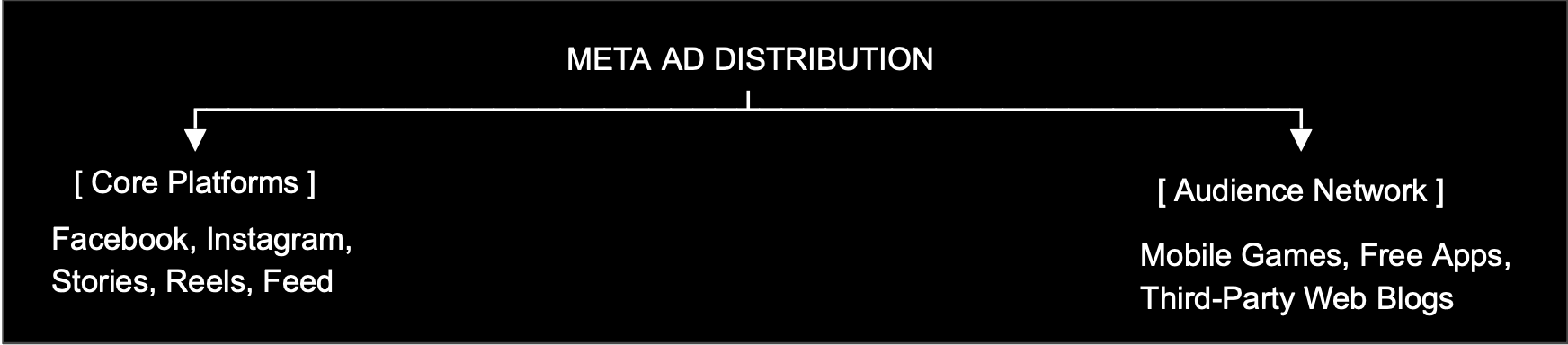
Meta Ad Distribution to different type of audience
What is the Audience Network?
The Audience Network consists of thousands of off-platform, third-party mobile apps, games, and websites that have partnered with Meta to monetize their traffic. When you play a free mobile puzzle game and a video ad pops up to give you extra lives, or when you read an article on a third-party news site and see a banner, that is the Audience Network in action.
Why is it called an "Audience Network"?
It gets its name because Meta isn't targeting a specific website or platform; it is targeting the user (the audience). If a user is active on Instagram, Meta tracks their device ID. When that same user opens a third-party mobile app outside of Meta's apps, Meta uses its "audience network" of publisher inventory to serve them an ad there instead.
The Catch with Audience Network
Audience Network inventory is vastly cheaper for Meta to fill than prime real estate like the Instagram Feed or Facebook Stories. However, traffic from third-party apps is notoriously prone to accidental taps, misclicks by kids playing games, and rewarded-video views (where users watch an ad just to get in-game currency, completely ignoring the product).
Real-World Account Benchmarks: Agency Experience vs. Platform Reports
At our agency (AIJODA), we manage ad spend across diverse client accounts, ranging from local service providers to direct-to-consumer product brands. When Meta rolled out its latest AI automation pushes, we tested them extensively.
Here is what we actually experienced on the ground, matching issues that many other media buyers face across the industry:
Scenario 1: Advantage+ On Audience and the "Spam Flood"
What Meta Promises: AI automatically expands your targeted demographics, using your audience suggestions as a starting baseline to find higher-converting users outside your specified criteria.
What We Experienced: A massive uptick in spam messages, fake form submissions, and low-intent clicks.
Why This Happens
Meta’s AI operates on mathematical optimisation. If you set your campaign objective to "Leads" or "Messages," the algorithm prioritises finding the absolute cheapest way to generate a form submission or an open chat.
When Advantage+ Audience expands broadly, it often routes ads to user profiles or placements that produce quick, low-cost actions. Unfortunately, many of these "leads" turn out to be bot accounts, misclicks, or users who fill out native forms with pre-populated, outdated contact details without reading the offer. The dashboard metrics look fantastic because your "Cost Per Lead" plummets, but your sales team gets stuck chasing dead ends.

Scenario 1: Advantage+ On Audience and the "Spam Flood"
Scenario 2: Advantage+ On Placement and the "Phantom View" Discrepancy
What Meta Promises: AI dynamically distributes your ad across Facebook, Instagram, Messenger, and the Audience Network to maximize budget efficiency and lower overall CPMs.
What We Experienced: Major reporting discrepancies. For instance, a campaign report shows 2,000 video views, but when we check the actual social post on the Page or Profile, it shows only 3 views.

Scenario 2: Advantage+ On Placement and the "Phantom View" Discrepancy
Where Did the Other 1,997 Views Go?
This discrepancy stems from how Meta aggregates off-platform placement data versus native social post engagement:
Off-Platform Video Delivery: When Advantage+ Placement is active, Meta dumps a huge portion of video ad budget into In-Stream Video or Rewarded Ads on third-party mobile apps (Audience Network) because those impressions are cheap.
Post vs. Impression Count: Views occurring inside third-party apps or banner units count toward your paid impression and view totals in Ads Manager. However, because those users are viewing the ad inside a separate mobile game or app, their views do not attach to the public engagement counter of your native Instagram or Facebook post.
Low-Quality Engagement: Worse yet, a large portion of those off-platform video plays come from users forced to wait 5 seconds to skip an ad inside a game. They aren't watching your video because they care about your product; they're holding their phone waiting for the "X" button to appear.
Comparative Analysis: Average Performance Benchmarks
To keep things grounded in real-world data, here is how automated AI placements compare to manually controlled placements across key metrics:
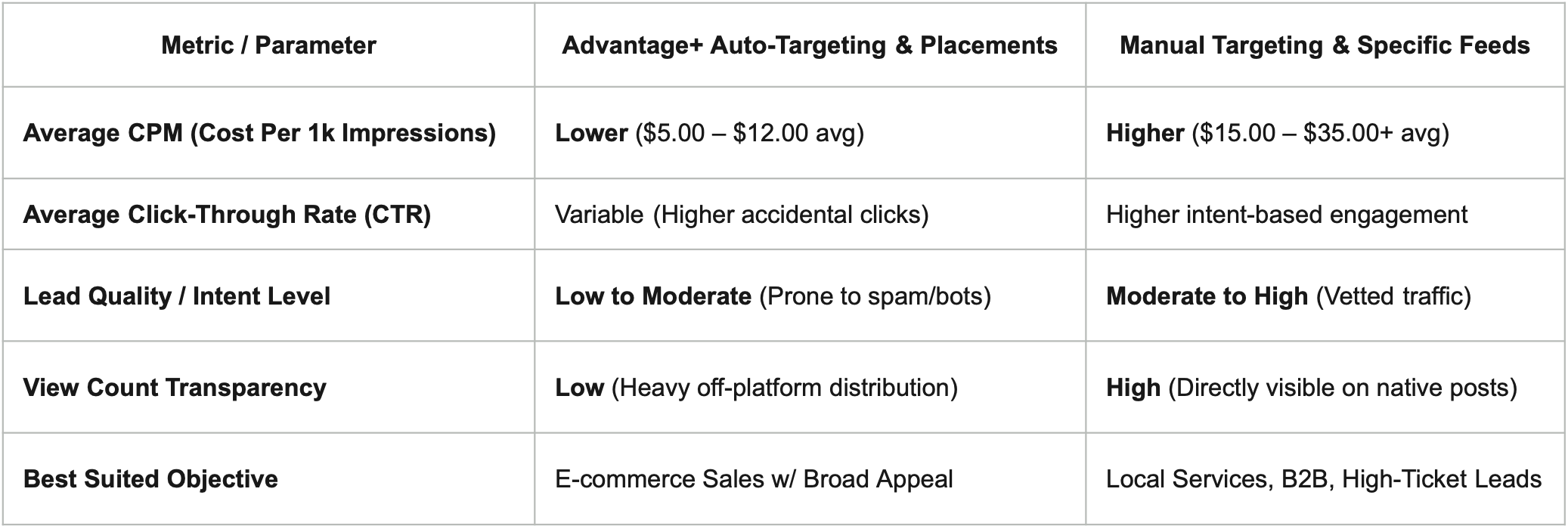
Average Performance Benchmarks: Manual Targeting vs Advantage+
The Verdict: How to Protect Your Budget While Using Meta AI
Meta’s AI tools aren't inherently malicious, but they are built to optimize for platform metrics, not necessarily your business's net profit. If you give the algorithm complete freedom, it will often naturally gravitate toward the cheapest, lowest-quality traffic available to hit its target numbers.
If you want the benefits of Meta's machine learning without burning your budget, consider these actionable rules of engagement:
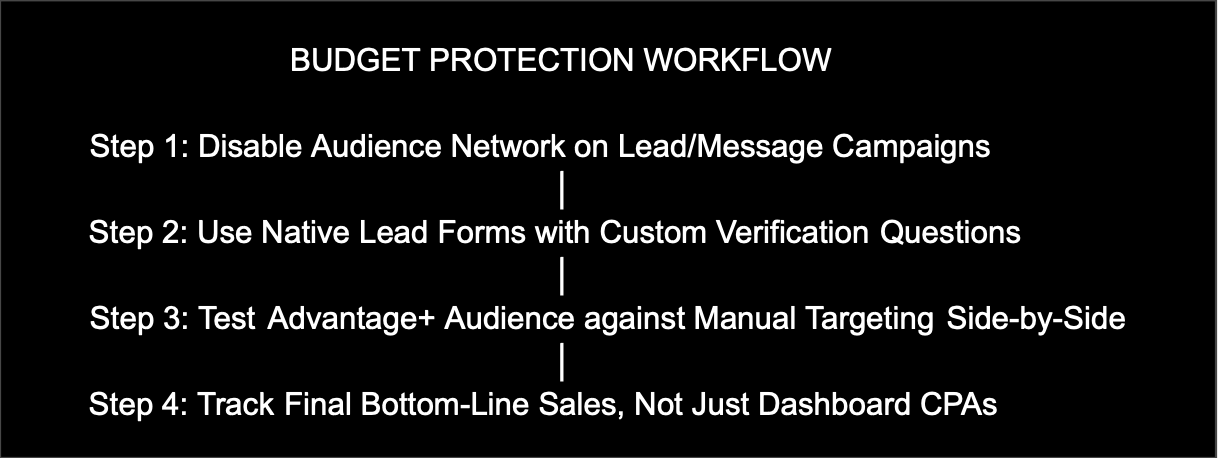
How to Protect Your Budget While Using Meta AI
Turn Off Audience Network for Lead Gen Campaigns: If you are running Lead Generation or Messenger ads, manually deselect "Audience Network" under placement settings. This single step eliminates up to 80% of fake form fills and bot spam.
Add Friction to Lead Forms: If you use Meta Native Lead Forms, turn on custom, non-autocomplete questions or multi-step confirmation screens. This prevents bots and accidental tappers from submitting fake data.
Use Placement Exclusions: If you want to leverage Advantage+ Placements for lower CPMs, go into your Brand Safety settings and upload publisher block lists to keep your ads off low-quality mobile apps.
Judge Performance by Final Revenue, Not Platform CPL: Never judge a campaign strictly by its reported Cost Per Lead in Meta Manager. A campaign generating $10 leads that never answer the phone is far more expensive than a campaign generating $30 leads that actually convert into paying clients.
-
Not necessarily. Advantage+ Audience can perform well for broad consumer e-commerce products where the target audience is naturally large. However, for high-ticket services or specific local businesses, starting with manual targeting controls often produces higher-quality conversions.
-
Automating placements allows Meta to clear inventory across its entire ecosystem, including third-party apps that would otherwise go unsold. It keeps average advertising costs looking low on paper while maximizing platform revenue.
-
In Meta Ads Manager, go to the Breakdown menu, select By Placement, and view your performance metrics. This shows you exactly how many impressions, clicks, and video views occurred on Facebook/Instagram versus the Audience Network.
